Category: News

  • Why Are Epoxy Resins So Expensive?

    Why Are Epoxy Resins So Expensive?

    Epoxy resin can be used in a variety of different projects ranging from designer tables to canvas art. It can be used for structural enhancement and visual preservation too. The diversity of fields that rely on epoxies might lead one to think that the material might become cheaper with time, yet it remains expensive. 

    Epoxy resins are expensive because they’re made with high-priced raw materials, require trained labor and precision, need costly marketing, and are often made in countries where all of the above cost more. In addition, these resins are sold in large quantities, which drives their price further up. 

    In this article, you’ll learn more about each of these reasons and also discover why trying to find cheaper epoxies can end up costing you a lot more in the end. To get a better understanding of epoxies before you embark on your project, read this short article. 

    High Price Raw Materials 

    Most retail products are marked up by 200% to 300%, but because the raw materials required to make these products are much cheaper than products like epoxy resins, you can buy them at a lower price than epoxy resin even though you’re overpaying by a lot more compared to the cost of production.  

    For instance, a Beats by Dre headphone costs $14 to make yet is sold for $450, according to some experts. Compare that to the $225 worth of raw materials required to produce $450 worth of high-quality resin, and you’ll realize that all things considered, epoxy resins aren’t that expensive. 

    This also brings us to an even more important aspect: cost-cutting. When a product’s high price is attributed mainly to its raw materials, you shouldn’t try to look for a steep price difference. Think about Gold: it is expensive because the material itself is expensive. If “gold” jewelry then costs ten times less than most Gold jewelry on the market, you should be cautious of the product’s genuineness. Epoxy resins that are much cheaper than the market rates are often made with low-quality raw materials. 

    Required Precision 

    If an epoxy resin is cheap yet contains decent raw materials, then it might require less precision to make. Such epoxies exist on the market, but most epoxies with the right hardening time and a decent finish require precision in manufacturing.  

    Precision comes with skilled labor, and highly skilled factory workers require a larger paycheck. Add to that the batches that might need to be thrown away because of imperfect proportions, and you get a situation where manufacturers cannot charge any lower than what they do. 

    This is also the key reason why you don’t want a “bargain.” And there’s more: you want to avoid cheaper epoxy not only because it might contain low-quality raw materials and imprecise proportions of said raw materials but also because it will impact the end result of your project.  

    To understand how you’ll lose more buying a cheaper epoxy, you need to divide your weekly pay by the number of hours you work to get your time’s market value. Let’s suppose your time is worth $20/hr, and you buy an epoxy that’ $40 cheaper than the market standard. 

    If this epoxy ruins a project that you worked 3 hours on, you’ve already lost $60. Add to that the epoxy you have to throw away, and the cost can go up to hundreds of dollars for larger batches. To avoid this, you can first purchase a smaller batch and do some test pours. The same is advisable for hardeners and pigment as well. Testing in small batches ensures that you are confident in every material required before introducing the contents to your project. 

    High Demand / High Marketing Costs 

    The risk one takes as an artist working with resin is that of demand difference. Epoxy resin is in demand and expensive, and you bet that the work you do with resin will make the end project even more expensive.  

    This can drive you to make even better work, so it is valued so high, the cost of epoxy doesn’t matter. Some artists and craftsmen might be tempted to go the other direction and find an epoxy so cheap that people won’t have to pay too much for the craftsperson to make a profit. 

    Epoxy resins can be expensive because the high demand for the material makes them harder to market. In theory, high demand should lead to high competition, and that should spark a price war that lowers the price. That doesn’t happen with epoxies because most dabbling manufacturers make poor-quality products and go out of business.  

    But since so many new manufacturers come to the market every year, the big players like Dr. Crafty and Superclear have to spend a lot of money marketing and branding their products to stand out. This also gets added to the cost of doing business, which results in a higher total price. 

    First World Manufacturing 

    From clothes to smartphones, a lot of what we consume in Western countries comes from labor outsourced to countries where the cost of living and working wages are both pretty low. This makes business sense and is sustainable enough to have become a widely accepted practice.  

    However, epoxy manufacturing in remote countries is not as easy to manage as making T-shirts. If a T-shirt is appropriately made, the quality controllers in the west can tell. However, if a factory in China makes faulty epoxy resin, it might take a few months before the business realizes, with an onslaught of negative reviews, that a certain batch doesn’t cure well, isn’t clear, or is prone to cracking. 

    The benefit of getting your epoxy resin manufactured in China is outweighed, for American businesses, by the risk of the lack of oversight. As a result, they prefer getting their products made in countries where they can oversee the process better. This comes with a higher cost of labor, electricity, and premises rental, driving up the overall cost. 

    Scale of Transaction 

    Finally, there’s the very simple mathematical reason behind why epoxy resins are expensive: because they’re often bought in a high quantity. Tens of dollars getting multiplied a few times can easily become hundreds and even thousands of dollars. If you buy a year’s worth of clothes in one go, they too will seem quite expensive! 

    Final Thoughts 

    Epoxy resins are high-utility products that come at a premium for the reasons listed above. Going for cheaper raw materials will only bring down the value of your product. So what’s the solution? Make your project so valuable that you can demand an even higher price. 
  • Is There a Difference Between Tree Sap and Tree Resin?

    Tree Sap 

    All trees produce a “sap”, to some degree. Tree sap is a translucent, thin, watery, slightly amber colored substance (just a tad little thinner than standard honey) that develops within the xylem and phloem cells of the trees. These cells are responsible for transporting water and nutrients throughout the tree, and carry water, hormones, sugar, and other minerals elements. 

    As a result, sap contains sugar and water, and extracted from trees using buckets and spiles. Maple syrup comes from the sap of Maple trees. A tree uses sap in two ways; they either: 1) pull sap from the water in the soil, transport it up through its trunk, and send it out through its leaf pores (stomata), or 2) sap flows down off of the leaves, towards the roots and other parts of the tree, because it contains the vital sugar (food) the tree synthesized in its leaves during photosynthesis. 

    Tree Resin 

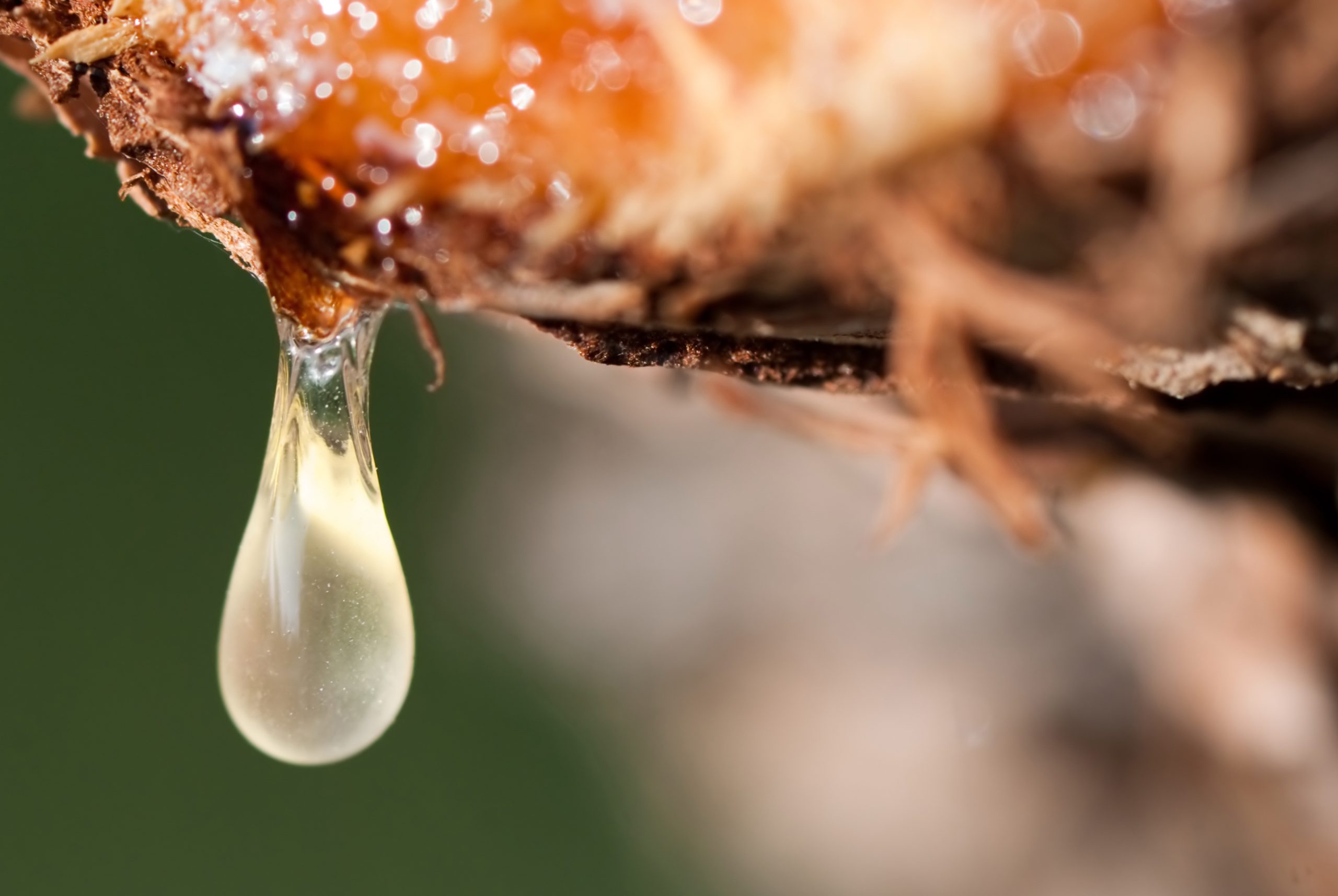
    Also known as “pitch”, tree resin is thicker, tackier, and darker than tree sap. Deciduous trees do not make resin; it is only produced by trees that belong to the Pinaceae family, such as pine, fir, and cedar. Resin forms in the outer cells of the trees, also known as the inner and outer bark. Outer bark is also known as the phloem. You can make a cut into a resin-producing tree, and see the resin ooze out of the bark. The resin is meant to work like a scab; it closes up the wound and protects it from outer elements while it heals. 

    Resin is sticky and clear, and composed differently than tree sap. It is composed of compounds secreted by or deposited in the tree and sometimes contains high levels of chemical properties. For this reason, it is used for a variety of commercial and industrial applications; maple syrup is not one of them. Resin is used to manufacture commodities like ink, lacquer, varnish, jewelry perfumes, and many other commercial products. 

  • What is a plant resin?

    Pine resin flowing from a cut surface.Pine resin. 

    What do you think of when someone says resin? Images of sticky, gummy sap-like substances instantly jump to mind and most people consider all these plant products to be resins. Not all these sappy liquids are resins however. 

    Resins are plant products that, 

    are not soluble in water, 

    harden when exposed to air, 

    do not play a role in the fundamental processes of the plant, and 

    are generally produced by woody plants. 

    Resins are produced in special resin cells in plants, and are also produced when an injury occurs to the plant. Resins can be produced through the bark of a tree, the flowers of an herb, or the buds of a shrub. 

    Think of a pine tree that has a missing tree limb. What do you see? Sticky “sap” flows from the tree, essentially making a bandage over the wound that hardens and eventually fossilizes into an incredibly hard substance called amber. 

    What is not a resin? 

    Spoon-leaved sundew.Carnivorous plants such as the spoon-leaved sundew (Drosera intermedia) use mucilage to trap insects. 

    Plants produce many compounds that can be confused with resins. These compounds include: 

    Gums 

    Mucilage 

    Oils and Fats 

    Waxes 

    Latex 

    Resinous Plants 

    Resins can occur as part of these other compounds, such as latex. Latex can contain resin, making the plant a resinous plant. There are many resinous plants all around the world. Although many resinous plants are not native to North America, some have established themselves here and are even considered weeds. 

    Conifers 

    cedar 

    fir 

    juniper 

    pine 

    redwood 

    spruce 

    yew 

    larch 

    Flowering Resinous Plants 

    mayapple 

    sweetgum 

    creosote bush 

    aspen 

    willow 

    birch 

    alder 

    poison oak and poison ivy 

    horse-chestnut, buckeye 

    gardenia 

    quinine 

    coffee 

    morning glory 

    parsley, dill, fennel, caraway 

    sarsaparilla 

    ginseng 

    rabbitbrush 

    balsam root 

    sunflower 

    tarweed 

    Spoon-leaved sundew.Conifer species, clockwise from top-left: western red cedar, Douglas fir, spruce, and lodgepole pine. 

    Liquidambar styraciflua.Sweetgum (Liquidambar styraciflua). Photo by Richard Webb, Self-employed horticulurist, Bugwood.org. 

    A Parry’s agave flower cluster.Rubber rabbitbrush (Ericameria nauseosa). Photo by Sarah Malaby. 

    Tabonuco 

    Tabonuco (Dacroydes excelsa).Tabonuco (Dacroydes excelsa). Photo courtesy Smithsonian Institution. 

    Tabonuco (Dacroydes excelsa) is a regal rainforest tree found in El Yunque National Forest in Puerto Rico. These magnificent native giants are the dominant large tree species that formerly covered all the lower and middle slopes of the mountains of Puerto Rico. They can grow to 100 feet tall with a diameter exceeding 40 inches. 

    Because of their beauty and resistance to decay, tabonuco trees have been used for all types of furniture, cabinetwork, boat construction and boxes. The smooth pale bark of tabonuco exudes a white resin that was used medicinally by early settlers and for making candles and incense. Tabonuco resin was also useful for making torches for starting fires and caulking material for boats. The endangered Puerto Rican parrot feeds on tabonuco seeds and the tree is rarely cut today. 

    People and Resins 

    Humans have used resins and amber for thousands of years. The trade of amber can be traced back to the Stone Age (3500 BCE) while the history of resin can be traced to just before 1700 BCE during the Bronze Age. 

    Amber 

    An ant preserved in amber.An ant preserved in amber. Photo by Mila Zinkova. 

    Amber is fossilized plant resin. Amber has been known to preserve insects and other small organisms that were imbedded in the resin before it hardened. 

    Amber is used for scientific research but it is used more widely for jewelry and art. It is often considered a gemstone although it is not a mineral. Amber can be many colors, including green, gold, brown, red, black, and even bluish. 

    The most well known and highly used amber comes from conifers, mostly pines; however, these same trees are not in existence today. Different amber sources have been dated from 40,000 years ago to 310 million years ago. 

    Amber can be found in deposits over many parts of the globe, generally in river deltas or sedimentary soils where water had washed plants downstream. The remaining plant structures, including their resin, fossilized and created amber. 

    European amber trade first began in the Stone Age, yet amber had been used ornamentally for hundreds of years before that. The best known amber deposit is from the Baltic Sea in north-central and Eastern Europe. From there, amber trade routes went to the Black Sea and the Mediterranean Sea and beyond. 

    Amber artifacts have been found in China (from Myanmar deposits) and Central America. Many cultures valued amber as religiously significant, due to its warm tones and ability to preserve life such as insects and plant parts. Other cultures used it to bargain for metal and necessities. Today, amber is still valued for its aesthetic beauty. 

    Incense 

    Box of Christmas Memories incense and holder.Balsam, cedar, and fir needle incense. Photo by Teresa Prendusi. 

    Traditionally, incense was derived from plant resins, commonly from frankincense and myrrh trees. Resin is tapped from the tree and allowed to harden. When it is burned, the hardened resin releases aromatic smoke. 

    Incense was a valuable commodity. Trade routes began from the southern coast of Arabia to the Mediterranean and Mesopotamia regions, beginning c. 1000 BCE and ending shortly before 500 CE. Incense was used in Egypt, Greece, Italy, China, India, and other places. Eventually, the trade routes collapsed because of better shipping routes, the loss of incense trees to agriculture, the demand for wood, and a decrease of rainfall in the region. 

    Other parts of the world, such as Central America, used resins for incense as well, although from plants native to those areas. Both the Maya and the Aztec used resin from the copal tree as incense. 

    Today, incense is made of other plant materials, in addition to resin, such as leaves, bark, seeds, fruits, roots, and rhizomes. 

    Resin 

    Hops (Humulus lupulus var. nemixicanus).Collection of pine resin for distallation to turpentine (“cup and gutter system”). Photo courtesy U.S. Forest Service. 

    Pictures of varnished furniture, cabinetry, and wall paneling.Lacquered furnishings. 

    Ship builders have used the liquid form of resin for thousands of years. It was used to waterproof rope and tarps, and was made into tar or pitch to seal the seams of wooden ships. 

    The British Empire used resin for its navy, originally buying it from the Baltic region. However, they had to find a new source of resin, of which the American Colonies had plenty, due to the abundance of pine trees. Because of the demand and use of pines for resin, the first conservation legislation in America was passed in Massachusetts, requiring permits to cut or de-bark pines. As sources of resin disappeared along the east coast, manufacturers looked elsewhere in America for resin sources. 

    After the Revolutionary War, Britain went back to the Baltic for its resin stores while the new United States stored its own resin for pitch and tar. At one point, the southern United States was the world’s supplier of resin. Since the pine forests of the Southern United States were exhausted, and resin collection by tapping trees was getting too expensive, manufacturers started using mechanical means of refining wood by-products to collect resin. Developing countries around the world still use traditional methods for as long as their sources last. 

    Turpentine and Rosin 

    Resin was also used to make turpentine and rosin. Turpentine was traditionally used in paints, but is now used in the chemical industry as a base to produce solvents, cleaners, fragrances, dry cleaning, and insecticides. It is also used in artificial flavors such as lemon, peppermint, and nutmeg, as well as cosmetics. 

    Rosin was discarded as a waste product until after the Civil War. It was used then as laundry soap but now as a variety of unrelated industrial products, such as adhesives, printing inks, and chewing gum. 

    Varnish and Lacquer 

    Varnish is plant resin combined with a solvent and drying oil (also derived from plants) to make it easier to apply to surfaces. It is commonly used for wood finishing and other crafts to provide protection and a glossy finish. 

    Natural lacquer is simply liquid resin. It is not mixed with any other solvents. Today, lacquer is a mixture of resin and quick-drying solvents; although in the United States, the name is used for a synthetic product. 

  • Resin shortages continue to affect composites supply chain

    A supply shortage of epoxy, polyester and vinyl ester resins, caused by U.S. winter storms and a variety of factors, continue to make headlines and affect the composites industry.  

    As reported by Gardner Intelligence chief economist Michael Guckes in his latest Composites Fabricating Index column, supply chain difficulties continue to restrict production, “which, in the face of strong demand, has caused a meteoric rise in backlog activity.” (See the latest Business Index columns here: compositesworld.com/hashtag/economics) 

    In response to this data and other industry reports, CW, with Gardner Intelligence, recently surveyed 144 composites fabricators to learn more about what the industry is experiencing. 

    Of the respondents, 69% reported experiencing or hearing of supply shortages over the past few months; 66% reported experiencing issues with lead times; 50% reported workforce or labor shortages; 21% reported wage rate escalation. 

    Winter storm impacts lead to continued resin shortages 

    From those surveyed, 62% of respondents reported that resins were a little or a lot more difficult than usual to acquire over the past three months. Polyester and vinyl ester ranked as the types most difficult to acquire, followed by epoxy. 

    Global supply chain shortages for many products have been impacting industries since the start of the pandemic in 2020, caused by pandemic-related and economic issues in transportation, rising demand and labor shortages. 

    Hexion CEO Craig Rogerson, during Hexion’s 2020 earnings call on March 10, acknowledged that the severe cold weather that hit Texas in February disrupted water service and raw materials supply to the company’s bisphenol A (BPA) plant in Deer Park, Texas, U.S., which compelled the company to declare force majeure and cease operations at the plant. The loss of Hexion’s BPA capacity led, subsequently, to a tightening in supply of epoxy and vinyl ester, for which BPA is a feedstock. Rogerson said Hexion expects to feel negative financial impact from the shutdown: “We will have a strong first quarter despite all of this, but there will be an impact.”The resin shortage, in particular, began as mid-February’s sub-zero temperatures and Winter Storm Uri affected much of the United States, hitting Texas and the Gulf Coast particularly hard. Widespread power outages and damage to water systems and infrastructure were experienced in the region for several days and weeks, causing temporary closures to oil refineries and petrochemical companies in the area, including local facilities of companies like Hexion (Columbus, Ohio, U.S.). 

    In reaction to the closures, many resin manufacturers and distributors declared force majeure on epoxy, polyester and vinyl ester products. Affected companies have reportedly included Olin (Clayton, Miss., U.S.), INEOS (Dublin, Ohio, U.S.), Covestro (Pittsburgh, Pa., U.S.), DuPont (Wilmington, Dela., U.S.), SABIC (Houston, Texas, U.S.), BASF Corp. (Florham Park, N.J., U.S.) and others. 

    One response from suppliers has been increasing prices for vinyl ester, polyester and other products from companies such as AOC (Collierville, Tenn, U.S.), Polynt Composites (Carpentersville, Ill., U.S.) and Lanxess (Pittsburgh, Pa., U.S.), as reported in CW’s frequently updated “Composite resins price change report.” In a March press release, AOC noted, “This action is due to the ongoing and significant escalation of costs for key raw material ingredients, packaging and freight resulting from Winter Storm Uri on February 15, 2021. AOC’s global purchasing resources continue to work with their network of suppliers to manage costs and meet customers’ needs.” 

    Shipping delays, other products affected 

    In addition to resins, 54% of survey respondents reported difficulty in acquiring fibers, with glass fiber topping the list, followed by carbon fiber (see “Glass fiber supply chain struggles amid pandemic, economic recovery” for recent CW coverage on the glass fiber supply chain). Among fiber formats, 51% of respondents reported challenges in acquiring fiber rovings; 42% reported chopped fibers; 35% woven fabric; 20% unidirectional tape; 14% multiaxial fabric. Forty three percent reported difficulty in acquiring core materials, particularly foam. 

    What’s causing all of these delays? One survey question asked respondents what suppliers are citing as reasons for supply disruptions; 55% of respondents reported shipping delays not related to weather; 48% reported unusually high demand; 35% reported inclement weather and winter storms; the remaining gave other responses. 

    Impact on fabricators 

    More than 54% of survey respondents reported that they are moderately or extremely concerned about ways the supply chain disruption may affect their operations. 

    How have fabricators been able to respond? More than 64% of survey respondents reported that they have been communicating with customers about potential delays; 41% reported seeking the same supplies from other suppliers; and 38% reported using alternative materials. Smaller percentages reported reduced shifts or layoffs/furloughs. 

    CW has also had the opportunity to connect with several fabricators about their experiences. Greg McLaughlin, composites manager at Sea Force Center Consoles (Palmetto, Fla., U.S.), reports, “Resin distributors are rationing resin deliveries, with large-volume builders first in line. We’re hearing the industry could face a four- to six-week delay in resin products due to the Texas freeze from damages related to processing plants’ piping and fittings.” 

    Faced with shortages on some resins and high prices on the resins that are available, he notes that boatbuilders and other fabricators are having to make decisions to use alternative resins for certain products. “The trickle-down effect of the Texas freeze has just started, and the bottom line is that boat manufacturers will be forced to make changes to fabrications, bill of material pricing, lead times and quality assurances, all of which will get passed down to the buyer.” 

    “We have production contracts where we were counting on ongoing supply of resin, and are now being told [by resin distributors] that it could be a month or more before we can get more in. Polyester, vinyl ester, gelcoat, epoxy – they’re all being impacted. As it trickles down, I’ll be unable to fulfill my own production contracts,” says Phil Locker, president of Competition Composites (Arnprior, Canada). 

    Returning to normal 

    Of respondents to the CW/Gardner Intelligence survey, 27% said they expect the supply chain situation to return to normal more than 16 weeks from now, and 41% said they did not know. 

  • Resin Crisis Update: What is Going on with Our Country’s Most Popular Polymers

    Last month, in our article “How to Get Your Injection Molded Parts On-Time and Keep Your Production Lines Running,” we addressed the lead times and production concerns around the resin industries and what Ferriot is doing to help our customers weather the storm. We will continue to update you on this evolving issue.   

    Plastics processors all over the country are seeing severe resin shortages and staggering price increases. Every indication is that this issue will continue through June.  What caused this? What resins have been impacted? How will this impact the resin market in the coming months? What should OEMs with plastic components in their products be doing now?   

    What Happened?   

    The root cause of this crisis is the COVID-19 pandemic (see diagram). 2020 and the beginning of 2021 have been a battle, especially for Texas and Louisiana resin manufacturers. Like many, resin manufacturers experienced some shift in product due to COVID-19 disruptions. To abide by COVID-19 rules and regulations, many plants ran into staffing issues as production facilities, shipping ports and supply chain logistics all saw a slow down when quarantined production shifts removed days of labor, as well as short staffing because of symptomatic employees. As a result, many thermoplastic resins were already in tight supply. Then, in the middle of the COVID-19 pandemic, the south saw one of the worst hurricane seasons in years causing increased delay, as well as damage. In February, the United States was hit with Winter Storm Uri resulting in power outages across the country.   

    Current Market Status   

    Now, several weeks later, the Louisiana and Texas plants are still recovering from the national winter/ice storm that caused so many shut-downs. Subsequently, there is more demand than supply for thermoplastics. According to Plastics Today, as of last week, at least 80% of domestic resin producers are in force majeure. Polyethylene, Acrylonitrile Butadiene Styrene (ABS), Polyvinyl Chloride (PVC), Acetal, Polycarbonate and Nylon being several major polymers that have been affected by this crisis.   

    What does this mean for us?  

    Why does that matter to you and the production of your injection molded parts? Well, Polyethylene is the most widely used plastic in the world, 85% of U.S supply being created in Texas. Without Texas plants able to produce and ship these essential plastics, we are going to start seeing significant plastic shortages, and potentially empty shelves at the store, in healthcare, automotive, construction, etc. Remember how the toilet paper shortage of 2020 resulted from the COVID-19 shutdown? It resulted in increased high demand. Many plastics consumers are going to buy out supplies as we continue to see a decrease in product. What does this mean? Higher prices, ongoing allocations, longer lead times, etc. According to Plastics Today, Polyproplene resin prices alone rose an average of 34 cents per pound in February and are expected to continue going up through March as a result of the strong global demand and short supply.   

    But since the storm is over, we should be moving forward, right? Not exactly. As recent as last week, Texas was still working to restore power to those who still don’t have it. However, once power is fully restored, plants must then evaluate the effects that this storm had – product allocation, order status, lead times, transportation, etc. Most plants that were affected by freeze related shutdowns did not anticipate the shutdown having this high of an impact. As a result, most plants were unable to properly prepare production and machinery for what resulted in the shutdown.  

    What should we do?  

    As we continue through the resin crisis, Ferriot recommends working with your current supplier to confirm allocations, as well as future supply. The resin crisis will continue to get worse before it gets better. We are anticipating this crisis lasting through June, if not longer. Our engineering services team can work with you and your suppliers to help identify alternative resins that you can use while we navigate these strange times. Learn about the pros and cons of each different resin and see if an approach to pivot your resin selection in the short team is something that your business should consider. Then, be ready to give long-term commitments for supply today, knowing that this crisis is set to continue for months to come, and low-priced resins will likely experience a pricing increase as this resin shortage continues to be a battle we face.   

    How are we going to avoid this in the future?   

    As we work to get past this crisis, an important thing to remember moving forward is to have a committed branded distributor. Talking with your distributor about your forecast for the year and volume requirements will not only help them plan and prepare for your demand, but it will also keep your company top of mind if a crisis does occur. Right now, in the resin crisis, companies are submitting orders to manufacturers and are getting terms such as “30-week lead times” thrown at them. When you have a committed relationship and requirement already in place with a manufacturer, your forecasted supply is already being factored in, resulting in quicker product response times. Having a committed relationship will also allow you to have some “buffer stock,” on hand when these types of delays occur again. Lastly, remember, resin crisis or not, the more lead time that you can provide your supplier, the less you will have to worry about hiccups delaying your products again!   

    Conclusion   

    As resin plants continue to regain power and recover from the latest setback, companies continue experiencing productivity issues due to labor challenges of COVID-19 and supply of both domestic and imported resins continues to fall short and worsen, the resin crisis remains an issue across the country. Consult Ferriot’s engineering services team and your branded distributor immediately to develop a plan on how your company can combat this setback. As a reminder, the best way to address the current resin crisis is to be proactive by taking these steps now:  

    Specify alternate resins and get them qualified. 

    Provide an extended forecast for production.  

    Consider making long term commitments on orders and resins.  

    Provide ample lead time on orders.  

    Prepare for cost increases.